
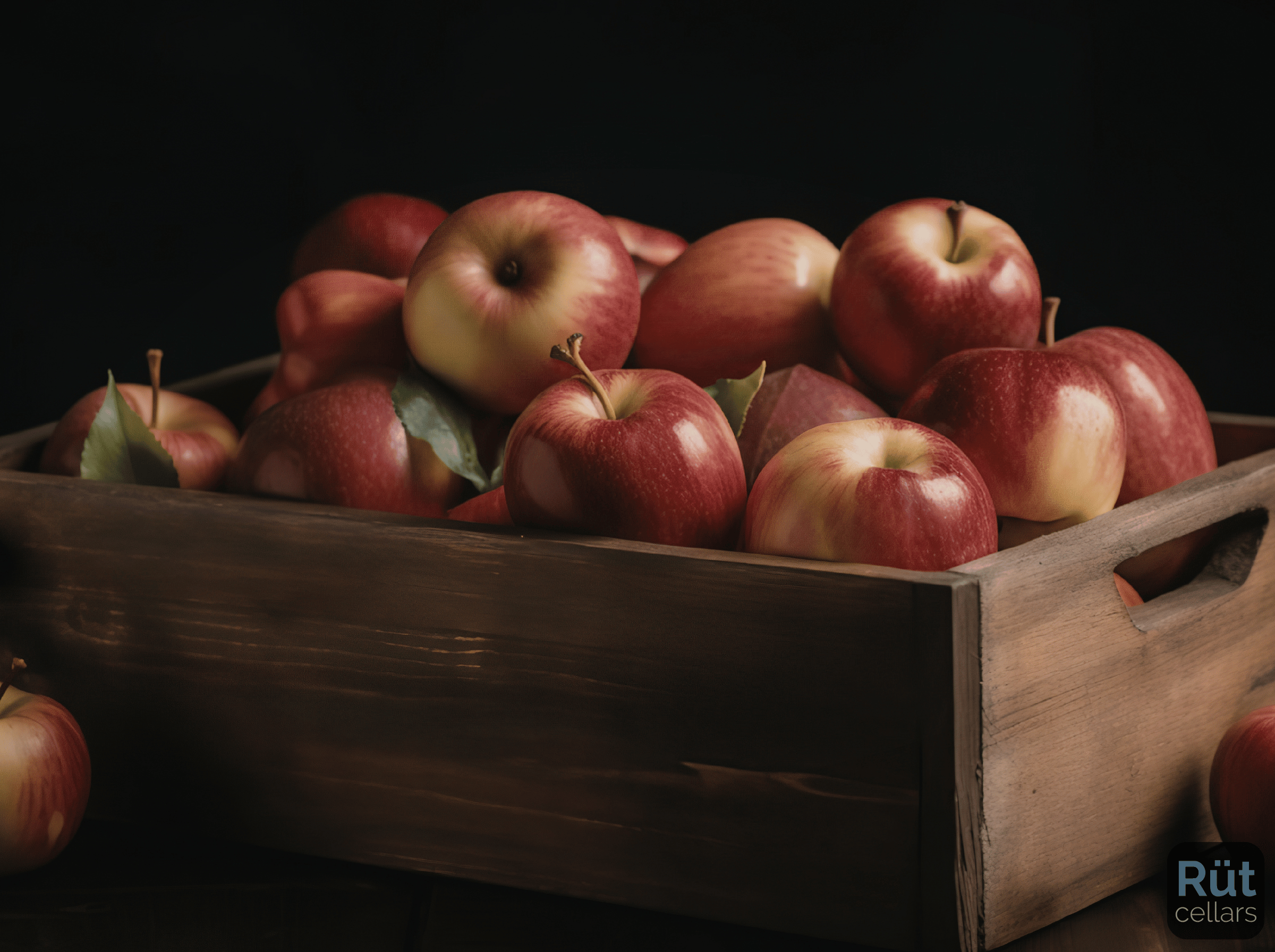
Managing Ethylene Conflicts in Home Storage
Understand which crops release ethylene and which are sensitive, then choose the right separation strategy for your home storage space — one room or two.
You've just finished setting up your home storage — zones labeled, bins in place, crops sorted by temperature and humidity. Then the last crate arrives: a full bin of apples from the orchard or the farmers market, ready for months of cold storage. Your carrots, cabbage, and potatoes are already settled in the corner. The question is whether the apples can move into the same space.
The answer depends on ethylene. Ethylene is a natural plant hormone released as fruit ripens, and in an enclosed storage space it doesn't stay near the fruit that produced it. It disperses through the air and reaches every crop in that space. For most vegetables that's inconsequential. For a handful — carrots, cabbage, and parsnips among them — even moderate ethylene exposure accelerates deterioration. Crops that should hold for months can decline noticeably in weeks.
Separation is the second layer of a working storage system. The first layer, from Guide #1, matched crops to the conditions your home can maintain. This guide manages the air inside those conditions: which crops release ethylene, which are most at risk, and how to arrange your storage space so you reduce that risk with the setup you already have.
What Ethylene Does in Your Storage Space
Ethylene is colorless and odorless at the concentrations found in home storage. Losses from it tend to look like "that crop just didn't hold" rather than anything with an identifiable cause — which is precisely why it goes unmanaged until you know to look for it.
What ethylene does in a storage space is accelerate the natural ripening or senescence process in crops that respond to it. In a closed or semi-enclosed area, it builds up — particularly where ventilation is limited and air turnover is low. UGA Cooperative Extension recommends proper aeration specifically to avoid ethylene accumulation, because sensitive vegetable crops in cold storage need to remain in a low-ethylene environment [2].
UC Davis Postharvest Technology Center provides a compatibility framework based on which crops produce ethylene and which respond to it, identifying room separation and ventilation as the two primary controls [1].
The practical consequence: the same tight, cold, low-ventilation conditions that protect your root vegetables from moisture loss also allow ethylene to accumulate when ethylene-producing crops are present. Your storage environment is working — until fruit and sensitive vegetables are sharing the same air.
Which Crops Release Ethylene
Not every crop in storage produces ethylene at levels that affect its neighbors. For most home storage situations, the two crops that matter most are apples and pears.
Nebraska Extension NebGuide G1264 addresses apples directly: they release ethylene as they ripen and should be stored separately from other crops when space allows [3]. Pears carry similar risk. Stone fruits — plums, peaches, nectarines — also produce ethylene, though they are less common in long-term cold storage. Melons produce at high rates but rarely enter months-long cold storage.
Volume matters here. A single apple in a large, ventilated basement has a negligible effect. A full bin of apples in a closed storage room creates a sustained ethylene environment that reaches every sensitive crop in that space. The home gardener who stores apples in the same basement as root vegetables is facing the most common scenario where thoughtful separation makes a real difference.
Which Crops Are Sensitive
Ethylene sensitivity varies considerably by crop. UMass Extension provides explicit sensitivity ratings for fall storage crops [4]:
| Sensitivity | Crops |
|---|---|
| High | Cabbage, carrots, parsnips |
| Moderate | Sweet potatoes, winter squash |
| Low | Beets, garlic, onions, potatoes |
High sensitivity: cabbage, carrots, and parsnips
Cabbage, carrots, and parsnips are the most at-risk crops in a typical home storage setup — and, not coincidentally, the vegetables most commonly stored alongside apples. Ethylene exposure causes carrots to develop bitterness, the result of a chemical response to the hormone, along with accelerated softening [4]. Cabbage leaves yellow and deteriorate faster than normal under sustained ethylene exposure [2, 4]. These are also the crops that represent the most labor and the longest storage commitment, which makes the risk worth managing deliberately.
Moderate sensitivity: sweet potatoes and winter squash
Sweet potatoes and winter squash respond to ethylene, but less acutely than root vegetables and brassicas [4]. Their placement in warm-dry storage at 55 to 60°F already separates them physically from most ethylene-producing fruit held in cold storage — so the separation may happen naturally if your zones are set up correctly. If apples and squash share a warm storage area, watch for premature ripening or skin changes.
Low sensitivity: beets, garlic, onions, and potatoes
Beets, garlic, onions, and potatoes are classified as low sensitivity [4]. They are not immune to very high ethylene concentrations, but in typical home storage conditions, the risk is low enough that they are not the primary concern. Focus your separation effort on the high-sensitivity group first.
Separation Strategies for Your Space
The goal is to keep ethylene-producing fruit out of the air shared by high-sensitivity crops. Three approaches, in priority order — be honest with yourself about which tier your setup can actually achieve.
Tier 1 — Separate rooms. The most effective approach. Put fruit in one enclosed space and sensitive vegetables in another: different basement rooms, a garage shelf versus a basement corner, a separate insulated cooler. UC Davis identifies room separation as the primary ethylene control for crop compatibility [1]. Nebraska Extension recommends separate storage for apples specifically [3]. If your home offers any practical way to hold these crops in different enclosed spaces, that is the right move.
Tier 2 — Separate areas within one room. When one room is what you have, maximize the physical distance between ethylene-producing fruit and high-sensitivity crops. Apples at one end of the room, carrot and cabbage bins at the other. Do not enclose both groups in the same cabinet, the same corner, or the same tight stack of bins. Separation within a single room reduces but does not eliminate ethylene exposure — and that's worth being clear about when you're deciding how much effort to put in.
Tier 3 — Ventilation as a partial control. UC Davis identifies ventilation with outside air as a mechanism to reduce ethylene accumulation [1]; UGA recommends proper aeration for the same reason [2]. In practice, managing air exchange into your storage space can help disperse accumulated ethylene. The limit here is real: introducing cold, dry outside air to address ethylene may compromise the humidity your root vegetables need. Use ventilation that preserves your storage conditions — a brief, managed exchange rather than a constant draft — and treat it as a supplement to physical separation, not a substitute.
Only Tier 1 removes the risk. Tiers 2 and 3 reduce it. If Tier 1 is achievable, prioritize it. If it isn't, Tiers 2 and 3 together are meaningfully better than no action.
Recognizing Ethylene Problems During Storage Checks
Ethylene damage is quiet. It accumulates across weeks, which is why it shows up in regular storage checks rather than arriving all at once.
The signals to watch for in high-sensitivity crops:
- Carrots: softening earlier than expected, or an uncharacteristic bitterness when you taste one during a check
- Cabbage: outer leaves yellowing faster than normal, or heads that were firm a week ago starting to loosen
- Parsnips: softening or developing off-flavor ahead of schedule
An unusually strong ripe-fruit odor when you open your storage space is also a signal worth noting. Ethylene itself is odorless, but the ripening it drives is not. A storage area that "smells ripe" in cold storage usually means ethylene is accumulating.
Nebraska Extension NebGuide G1264 recommends regular inspection of stored produce and prompt removal of anything showing early signs of decay [3]. A deteriorating crop adds to the ethylene environment and accelerates decline in everything around it. Removing it quickly is one of the more direct ethylene-management actions available during the storage season.
The full checking routine — what to look for, how often, and what to do when something looks off — is covered in the next guide in this series. Monitoring and Checking Your Storage walks through what observation alone can tell you, when a basic thermometer or hygrometer helps, and how to build a realistic inspection routine that doesn't require specialized equipment.
Managing the Air Is the Second Layer of Storage
Separating ethylene-producing crops from ethylene-sensitive ones is the most consequential decision you make after getting temperature and humidity conditions right. Guide #1 established the space. This decision manages what moves through it.
Who this applies to: Home gardeners and bulk-buyers storing apples, pears, or stone fruit in the same space as root vegetables, cabbage, or other ethylene-sensitive crops.
When it matters: Before the fruit moves in. Separation is straightforward when you're placing bins for the first time. It becomes a reorganization project when the storage space is already full.
Where to apply it: Any home storage space where ethylene-producing fruit and ethylene-sensitive vegetables share enclosed air — basement, garage, cool room, or insulated cooler.
Why it matters: Cabbage yellows, carrots develop bitterness, and parsnips soften ahead of schedule when ethylene from nearby fruit reaches them during cold storage [2, 4]. The loss isn't sudden — it builds quietly across the weeks they are stored together.
How to do it: Achieve Tier 1 separation (different rooms or enclosed spaces) when your setup allows it. Apply Tier 2 (maximum distance within one room) and Tier 3 (managed ventilation) together when it doesn't. Inspect high-sensitivity crops regularly and remove any deteriorating produce promptly to keep the ethylene load low [3].
Your next steps in this series:
- Monitoring and Checking Your Storage — how to read your storage through regular observation, what visible signs tell you, and how to build a checking routine that doesn't depend on equipment
- The Simple Storage Routine — a month-by-month maintenance framework that keeps the whole system working through winter
Looking back: If you're still working through zone setup and initial layout, begin with Setting Up Your Home Storage. The separation decisions in this guide build directly on that foundation.
Field rule: If the apples and the carrots share an enclosed space, they share the same air. Separate rooms when you can. Maximum distance when you can't. Inspect regularly. Remove decay promptly.
Sources
- 1web-university-research: [UC Davis Postharvest Technology Center: Compatibility Chart for Short-term Transport or Storage](https://postharvest.ucdavis.edu/compatibility-chart-short-term-transport-or-storage)
- 2web-university-extension: [UGA CAES Publication C1205: Quick Storage Guide for Vegetable Crops](https://fieldreport.caes.uga.edu/publications/C1205/quick-storage-guide-for-vegetable-crops/)
- 3web-university-extension: [Nebraska Extension NebGuide G1264: Storing Fresh Fruits and Vegetables](https://extensionpubs.unl.edu/publication/g1264/na/html/view)
- 4web-university-extension: [UMass Extension: Optimal Storage Conditions and Ethylene Sensitivity of Fall Storage Crops](https://www.umass.edu/agriculture-food-environment/vegetable/fact-sheets/optimal-storage-conditions-ethylene-sensitivity-of-fall-storage-crops)
Need help?
Ask support if you have any questions about food storage.